Finding reliable, high-paying clients often feels like a lottery. You've spent countless hours perfecting your portfolio with sleek animations, custom fonts, and cutting-edge design trends that impress you. Yet, the leads coming in are for low-budget, generic projects.
The painful truth? Your stunning portfolio might be the very thing pushing away the high-budget clients you crave. While you’re showcasing your artistic flair, they’re looking for something entirely different: solutions, impact, and a clear return on investment.
In 2026, the elite clients aren't browsing for "cool"; they're searching for "competent" and "strategic." They don't care about your personal aesthetic as much as they care about their bottom line.
In this guide, we’ll expose why a self-focused portfolio repels premium clients and show you how to pivot your showcase into a powerful, client-centric conversion tool.
The "Ego-Driven" Portfolio: A High-Budget Repellent
To understand why your current portfolio isn't working, you need to step outside your designer mindset and into a client's.
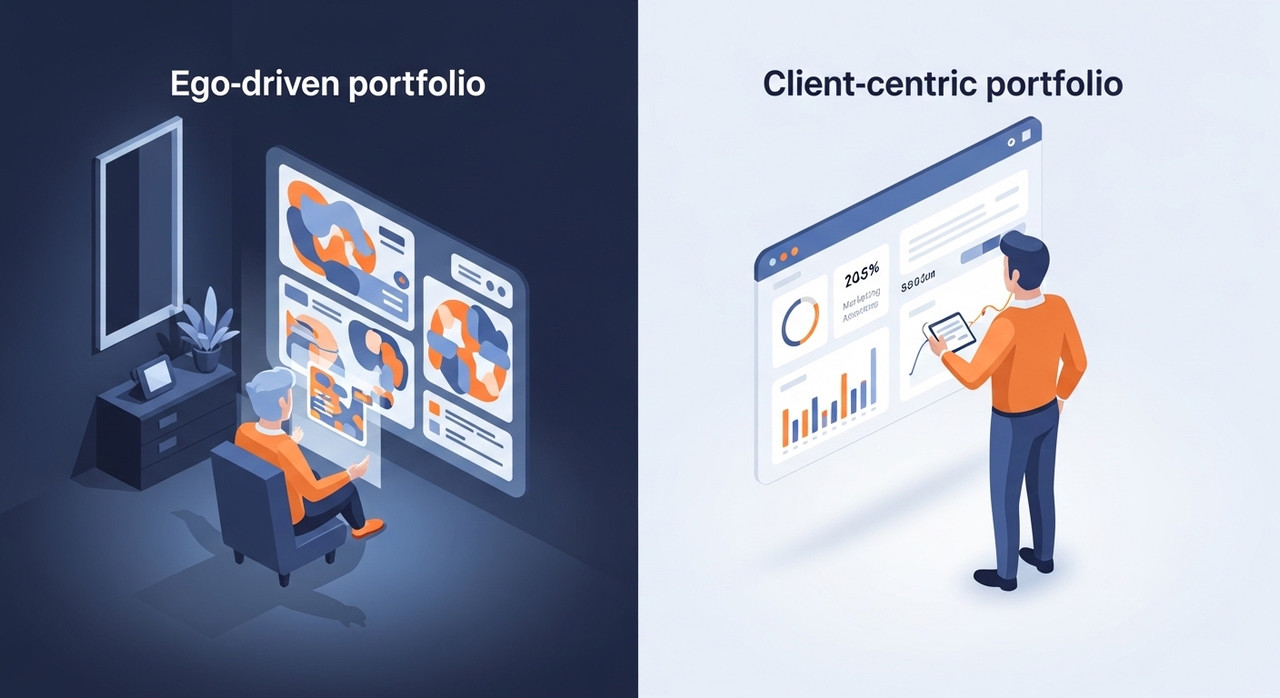
Traditional (Ego-Driven) Portfolio: Focuses on individual pieces, showcasing visual creativity, technical skills, and personal style. It's often curated like an art gallery.
Client-Centric Portfolio: Focuses on case studies, demonstrating problem-solving, measurable results, and strategic thinking. It's curated like a business proposal.
The Result:
- Misaligned Value: You highlight art; they seek ROI.
- Lack of Context: Without project goals and outcomes, your work is just pretty pictures.
- Perceived Risk: High-budget clients need assurance you can solve their specific problems, not just create something aesthetically pleasing.
Why High-Budget Clients Care Less About "Pretty"
Beyond simple aesthetics, there are three critical reasons why top-tier clients demand a different kind of portfolio.
1. They're Buying Solutions, Not Just Design
High-budget clients aren't paying for pixels; they're paying for problems to be solved. They want increased conversions, better user engagement, reduced bounce rates, or a stronger brand presence. Your portfolio needs to illustrate your problem-solving process and the impact of your work, not just the final output.
2. Risk Mitigation is Key
Investing a significant budget into design is a risk for any client. Your portfolio's primary job is to mitigate that risk by demonstrating a consistent track record of success. Generic "mood boards" and aesthetically pleasing but unexplained mock-ups only increase their perceived risk. They need proof of concept and reliable outcomes.
3. They Seek Strategic Partners, Not Just Executioners
Premium clients want a collaborator who understands their business goals, not just someone who executes instructions. Your portfolio should communicate your strategic thinking, your ability to ask the right questions, and your capacity to contribute to their broader objectives. This means showcasing your thought process, not just the polished end product.
Comparison: Ego-Driven vs. Client-Centric Portfolios
| Feature | Ego-Driven Portfolio (Self-Focused) | Client-Centric Portfolio (High-Budget Focused) |
|---|---|---|
| Primary Goal | Show personal style & skill | Demonstrate problem-solving & results |
| Content Focus | Final designs, visuals, animations | Case studies, process, data, testimonials |
| Narrative | "Look what I made!" | "Here's how I solved X for client Y, achieving Z" |
| Call to Action | "Hire me!" | "Let's discuss your specific challenge" |
| Client Takeaway | "This person is talented" | "This person can deliver value and ROI" |
Step-by-Step: Transforming Your Portfolio for High-Budget Clients
Ready to reframe your work for maximum impact? Follow this practical workflow.
Step 1: Identify Your Ideal Client's Problems Instead of thinking "what do I want to show?", think "what problems do my dream clients need solved?". Are they struggling with low conversions? Poor user experience? An outdated brand? Select projects that directly address these pain points.
Step 2: Reframe Projects as Case Studies For each project, create a detailed case study that includes:
- The Challenge: What problem did the client face?
- Your Process: How did you approach it? (Research, wireframing, iterations)
- The Solution: The design you delivered.
- The Impact/Results: Quantifiable outcomes (e.g., "increased conversion by 15%", "reduced bounce rate by 20%"). Use screenshots, charts, and testimonials.
Step 3: Lead with Results, Not Razzle-Dazzle Your portfolio homepage and each project thumbnail should immediately communicate the result or value proposition of the project, not just a beautiful image. Use strong headlines like "Boosted E-commerce Sales by 20%" rather than "E-commerce Website Redesign."
Step 4: Integrate Client Testimonials Strategically Don't just have a separate "testimonials" page. Embed relevant quotes directly within each case study to build immediate social proof for that specific project.
Step 5: Optimize for "Skim-Reading" High-budget clients are busy. Use clear headings, bullet points, and bolded text to make your case studies easily scannable. Your goal is for them to grasp the value proposition and results in under 60 seconds.
Conclusion
Your portfolio isn't an art exhibition; it's a business development tool.
In 2026, the freelancers and agencies landing the biggest deals are those who understand that top-tier clients prioritize problem-solving, strategic thinking, and measurable impact over purely aesthetic appeal. By shifting your focus from "what I made" to "what problem I solved and what value I delivered," you'll transform your portfolio from a self-indulgent showcase into a powerful magnet for high-budget clients.
Ready to enhance your workflow as a Freelancer or Business Manager? Try Flowlancerr now!
